
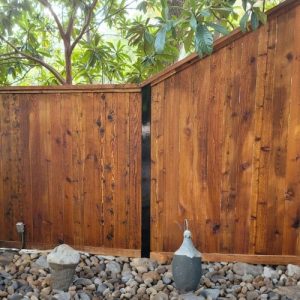
 If you’re picking between cedar and vinyl for your Round Rock fence, the Texas heat plays a bigger role in the decision than most homeowners realize. Both materials work in Central Texas. Both have homeowners who swear by one or the other. We’ve installed thousands of cedar privacy fences and a growing number of vinyl fences across Round Rock and the wider Williamson County area since 2012, so we’ll share what holds up and what doesn’t in this climate.
The short answer: Cedar is more affordable upfront but requires regular staining to look good in Round Rock’s conditions. Vinyl costs more initially but doesn’t need staining or refinishing. Both can last 20+ years with proper care. The real choice comes down to whether you want to budget for periodic staining or pay more upfront to skip the maintenance schedule entirely.
How Round Rock Heat Affects Each Material
Texas summer pushes both materials. Here’s what happens to each:
Cedar in the Sun
Cedar dries out quickly in the direct Texas sun. UV breaks down the natural oils that protect the wood, causing the silver-gray weathering most homeowners recognize. South and west-facing cedar fences in Round Rock weather faster than north-facing ones. Without periodic cedar fence stain refresh, untreated cedar can show significant graying within 12 to 18 months. Stained cedar holds color and moisture protection for 2 to 4 years before needing reapplication.
Vinyl in the Sun
Vinyl is engineered to resist UV degradation, but Texas heat is harsher than what manufacturers test in. Quality vinyl fences hold color well for 15 to 20 years. Lower-quality vinyl can show fading, chalking, or yellowing in 5 to 8 years under the direct Texas sun. The dark colors (gray, tan, sandstone) are more heat-sensitive and may fade sooner than white vinyl. Heat expansion is also real: vinyl expands and contracts more than cedar with temperature swings.
Cost Comparison Over 20 Years
Cedar costs less to install. Vinyl costs roughly 1.5 to 2 times as much upfront for equivalent linear footage. The math changes when you factor in 20 years of ownership: cedar requires staining every 2 to 4 years (about 5 to 10 stain cycles over 20 years), plus possible board replacement in damaged sections. Vinyl typically needs only cleaning (homeowner-handled) and occasional repair of cracked panels. The 20-year total cost comes out roughly even between the two materials, though cedar’s costs are spread over the years, while vinyl’s are mostly upfront. Note: we don’t quote specific dollar figures here because pricing changes; the on-site quote process produces accurate numbers for your specific lot.
Durability and Common Failure Modes
Each material fails differently when it does fail:
How Cedar Fails
Cedar fails through gradual weathering, individual board damage, and post rot. Boards can warp, cup, split, or crack as they age. Storm damage is repairable; we’ll replace the damaged board or section. Post rot at the ground line usually shows up in years 12 to 18 and requires post replacement. Board-by-board cedar fixes are routine work for our crews because individual board or post fixes are straightforward.
How Vinyl Fails
Vinyl fails through cracking, fading, and panel damage. Cracking most often occurs during freeze events, when the material becomes brittle. Lawn equipment impact can permanently damage vinyl panels. Repairs require panel replacement, and matching color across faded older panels can be difficult. Vinyl does not develop post-rot since the posts are typically vinyl-sleeved metal or all-vinyl.
Appearance and Aesthetic Differences
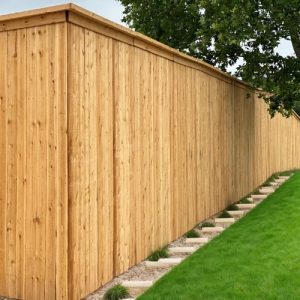
Cedar gives a natural wood appearance with visible grain, warm tones, and the option for stain colors ranging from clear to dark walnut. The wood look matches traditional Texas residential design, especially in older Round Rock neighborhoods. Vinyl gives a clean, uniform appearance with limited color options (typically white, tan, sandstone, or gray). Vinyl resembles painted wood from a distance but reads as plastic up close. Some homeowners love the clean look; others find it too uniform. Traditional cedar fence builds suit traditional landscaping; Low-maintenance vinyl panel installs suit modern or low-maintenance properties.
HOA Approval Differences
Virtually every Round Rock HOA approves Cedar. Vinyl approval varies. Older HOAs sometimes restrict vinyl to specific color and style options or prohibit it entirely. Newer master-planned communities typically allow both. Forest Creek HOA standards approve cedar by default and have specific criteria for vinyl approval. Confirm vinyl approval with your HOA before committing to the material.
Material Trends Across Williamson County Neighborhoods
The cedar vs vinyl split varies by neighborhood:
Pflugerville’s newer subdivisions show steady adoption of vinyl among homeowners seeking low maintenance. Hutto residential subdivisions run heavy on cedar for the traditional residential look. Hill-lot fence work in Cedar Park uses both materials, with vinyl preferred on lots with extensive sun exposure. Master-plan fence rules in Leander typically default to cedar, but increasingly approve vinyl options. Taylor’s Samsung-corridor builds run mixed materials based on individual HOA standards.
How to Decide: Cedar or Vinyl for Your Round Rock Fence
Choose cedar if you want a traditional wood appearance, are comfortable with periodic staining maintenance, and prefer a lower upfront cost. Choose vinyl if you want minimal maintenance, prefer uniform color over wood grain, and can absorb the higher upfront investment. Both will last 20+ years with proper care in Round Rock. Maintenance preference matters more than technical specifications. We’ve installed both for happy homeowners across Williamson County, so the right choice is the one that matches your property and lifestyle. You can’t go wrong with the materials; just with the maintenance commitment.