Cedar Wood Privacy Fence Installation in Round Rock, TX
Round Rock Fence Company installs cedar and pine wood privacy fences across Williamson County in board-on-board, side-by-side, shadow box, and modern horizontal styles. 6-foot and 8-foot heights with HOA-compliant specs. Veteran-owned, fully insured, free on-site estimates, one-year workmanship warranty.
To Receive a Free Estimate
Fill Out This Form
Cedar wood privacy fencing is the default choice for Round Rock homeowners who want backyard privacy, pet containment, and curb appeal that matches Central Texas home architecture. Most HOA-governed communities in Williamson County require wood privacy fencing for backyards, typically in cedar with specific stain colors. Every wood fence project starts with a free cedar fence estimate, during which we measure the property and walk through style options.
We’ve installed wood privacy fences across Round Rock, Pflugerville, Hutto, Cedar Park, Georgetown, and the surrounding Williamson County communities since 2012. Cedar expertise matters because each community has specific style and stain color requirements that affect what you can install. Learn more about our wood fence crew and the wood projects we’ve completed.
Why Choose Wood Privacy Fencing
Wood privacy fencing has advantages that no other material can match, which is why it remains the most common fence type in Central Texas.
True Sight-Line Privacy
A 6-foot or 8-foot solid wood fence blocks views completely. Board-on-board wood construction is the gold standard for actual privacy in Round Rock.
Natural Aesthetic and HOA Compliance
Cedar weathers beautifully whether stained or left to silver naturally. Nearly every HOA-governed community in Round Rock requires wood privacy fencing. We know the approved stain colors, heights, and style requirements for Teravista, Sun City, Berry Creek, Forest Creek, Sendero Springs, Paloma Lake, and most Pflugerville communities.
Lower Upfront Cost
Cedar privacy fencing costs significantly less per linear foot than vinyl, iron, or aluminum. For a 150-foot backyard perimeter, the cost difference vs vinyl can cover several rounds of staining.
Wood Privacy Fence Styles We Install
Four primary wood privacy styles cover most applications in Round Rock.
Board-on-Board
Overlapping vertical boards on alternating sides of the rail. Blocks sight lines completely, looks symmetrical from both sides, and resists gaps when boards shrink in summer heat. The premium style and the standard for Teravista, Sendero Springs, Falcon Pointe, and Blackhawk HOA requirements.
Side-by-Side (Dog-Ear)
Vertical boards butted side by side with dog-ear, flat, or French Gothic tops. The most common wood privacy style in Central Texas is because it balances cost and privacy effectively. Works well in Hutto, Taylor, and parts of Leander, where HOA rules allow flexibility.
Shadow Box
Boards alternating on both sides of the rail with a slight gap between. The fence looks identical from both sides, which is why Paloma Lake and some Georgetown HOAs encourage or require it.
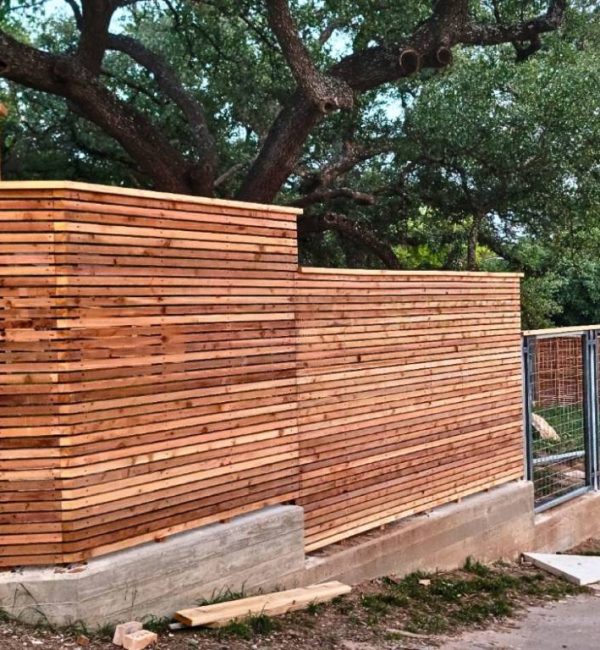
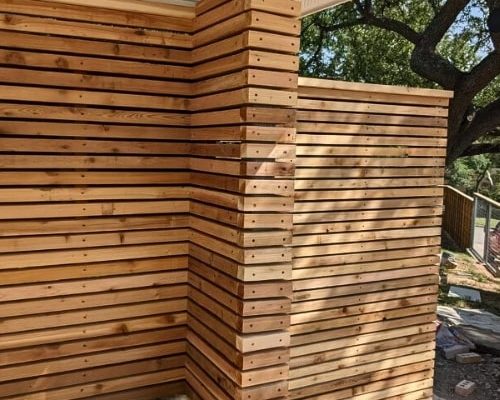
Modern Horizontal
Horizontal board orientation for a contemporary look. Popular in newer Pflugerville and Cedar Park subdivisions, where modern architecture calls for non-traditional fence aesthetics.
Cedar vs Pine Fence Boards
Cedar’s the premium choice for Central Texas wood fencing. Natural oils in cedar resist rot, insects, and warping better than pine. A cedar fence lasts 15 to 20 years. Pressure-treated pine costs less and lasts 8 to 12 years, making it viable for budget projects or rural acreage.
Wood Fence Maintenance Lifecycle
Wood fences require predictable maintenance over their service life. Unlike vinyl or iron, wood responds to Central Texas weather cycles and needs periodic care. Here’s what the timeline looks like.
Year 0 to 1: Installation and Seasoning
Fresh cedar has natural oils that protect the wood. No staining is needed immediately. The fence dries and seasons over the first 6 to 12 months. Minor splitting, cupping, and silvering are all normal.
Year 2 to 3: First Stain Application
Cedar is dried enough by year 2 or 3 to accept stain evenly. Semi-transparent stain preserves the natural grain while adding UV protection. Solid stain gives the longest protection. Our wood staining details page covers product options.
Year 5 to 7: Second Stain Refresh
UV exposure fades stain color over 3 to 4 years in Central Texas sun. A second application in years 5 to 7 restores the color. You’ll notice the fading most on the south and west-facing sides first.
Year 10 to 15: Board Replacement
By years 10 to 15, individual boards may have cracked, split, or rotted at ground contact. We’ll replace damaged boards individually rather than rebuild. See our fence repair options.
Year 18 to 25: Replacement Decision
Most cedar fences reach end-of-life between years 18 and 25. Posts typically fail before reaching the boards due to ground-contact rot. When post integrity drops, full replacement is more cost-effective than continued repair, and it’s time to replace an aging wood fence.
Wood Privacy Style Preferences Across Williamson County
Wood privacy fence style preferences vary widely across communities in the Round Rock area. Teravista and Sendero Springs HOAs mandate board-on-board cedar. Forest Creek and Walsh Ranch default to side-by-side cedar at 6-foot heights, the most common style across Central Texas. Paloma Lake HOA rules encourage shadowbox cedar because the alternating boards look the same on both sides. Pflugerville master-planned communities like Falcon Pointe and Blackhawk require board-on-board with specific dark stain colors. Sun City, Texas, stays with 6-foot cedar privacy as the retirement community standard. Liberty Hill and Taylor lean toward rough-cut cedar or pressure-treated pine for ranch-style acreage perimeters.
Cedar’s the premium choice across almost every Round Rock neighborhood because it resists rot, insects, and warping better than pine. Pine shows up primarily on budget-conscious ranch installations. Post setting follows our 24-inch minimum depth, with deeper footings in the heavier clay pockets of Teravista and Sendero Springs.
Wood vs Other Fence Materials
Wood privacy isn’t the right choice for every property. For zero-maintenance fencing, a vinyl fence comparison covers styles that never need staining. For pool-code applications, decorative iron fencing offers security with visibility. For a cost-effective perimeter, a chain link option makes sense. Wood’s strengths are privacy, natural aesthetics, HOA compliance, and lower upfront cost.
Why Round Rock Homeowners Choose Us for Wood Fencing
Round Rock Fence Company has installed wood privacy fencing across Williamson County since May 2012. Wood expertise matters for three reasons: post-setting depth determines whether the fence leans within 5 years; HOA approval navigation requires knowing each community’s stain and style rules; and lumber grade selection affects the total service life. We handle all three. We’re veteran-owned, fully insured, and every wood installation comes with a one-year workmanship warranty. Read our customer testimonials from past wood fence customers.
Frequently Asked Questions
How often does a cedar fence need to be stained?
Every 3 to 4 years in Central Texas. UV exposure and summer heat cause stains to fade faster here than in cooler climates. Initial staining occurs 2 to 3 years after installation, once the cedar is fully dry. Semi-transparent stains need more frequent reapplication than solid stains.
Which is better for Round Rock, cedar or pine fence boards?
Cedar is the better choice for almost every Round Rock project. It resists rot, insects, and warping better than pine and lasts 15 to 20 years compared to pine’s 8 to 12. Pine’s a viable budget option for rural acreage. Over a 20-year timeframe, cedar’s almost always cheaper total cost.
Which wood fence style is best for HOA-governed communities?
Most HOA communities in the Round Rock area require board-on-board cedar with specific stain colors and height limits. Teravista, Sendero Springs, Falcon Pointe, and Blackhawk all mandate board-on-board. Forest Creek and Walsh Ranch allow side-by-side. Paloma Lake encourages shadow boxing. We’ll confirm your community’s specific rules before the estimate.
Will a cedar fence warp or split over time?
Some minor splitting and cupping is normal for cedar during the first year as the wood dries. Significant warping usually indicates lower-grade lumber or improper post-setting. We install higher-grade cedar with 24-inch minimum post depth, which prevents the warping issues common on discount installations.
Can individual wood boards be replaced without rebuilding the fence?
Yes. Individual board replacement is common during the 10- to 15-year maintenance window, when older boards may crack or rot. We’ll match the existing stain color as closely as possible, though new boards often look slightly different until weathering blends them with the surrounding fence.
How tall can a wood privacy fence be in Round Rock?
Most Round Rock residential properties allow 6- to 8-foot wood privacy fences in backyards, with 3- to 4-foot limits in front yards. HOA rules are typically more restrictive than city code. We’ll check city and HOA rules before any installation.
Is board-on-board worth the extra cost over side-by-side?
For HOA communities that require it, yes. For flexible communities, board-on-board runs roughly 15 to 25 percent more than side-by-side but eliminates sight-line gaps when boards shrink in summer heat. Side-by-side remains the cost-effective standard where HOA rules allow it.
Request a Free Wood Fence Estimate
Every wood privacy fence project starts with a free on-site estimate. We’ll measure the property, review style options, confirm HOA stain colors and height limits, and send a written quote the same week. For details on our installation process, see the full installation page. Call (512) 236-5154 or reach out for a cedar quote to get started.