
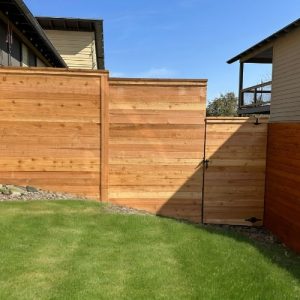
 If you’ve got a cedar fence in Round Rock, Pflugerville, Cedar Park, or anywhere in the Williamson County area, you’ve probably wondered when it’s time to restain. The honest answer: most cedar fences here need refreshing every 2 to 4 years. We’ve installed and stained thousands of cedar fences across the area since 2012, and we’ll walk through the factors that determine your specific timing.
The 2- to 4-year window is wider than most online guides suggest because Central Texas conditions vary widely. A south-facing fence in full sun on a Round Rock corner lot weathers faster than a north-facing fence shaded by mature trees. Reading the actual condition of your fence matters more than counting years on the calendar.
What Determines How Often Your Cedar Fence Needs Staining
Five factors drive the timing more than anything else. We’ll cover each so you can read your own fence:
Sun Exposure (the biggest factor)
South and west-facing fence sections take direct sun for hours every afternoon, especially during the brutal July through September stretch. UV breaks down stain pigments and dries the wood underneath. North-facing sections in shade can hold a stain for 4 to 5 years. South-facing sections in full sun might need restaining every 2 years. We’ve seen this on the same property: one side of the yard looks fine while the other side is gray and weathered.
Type of Stain Originally Applied
Solid stains last longer than semi-transparent stains because they form a film on the wood that blocks UV. Semi-transparent stains soak into the wood, letting the grain show through, but they offer less UV protection. Oil-based stains generally outlast water-based stains on cedar. Our cedar fence stain application uses high-quality semi-transparent oil-based stains for most projects because they balance protection with the natural cedar appearance most homeowners want.
Age and Condition of the Boards
Newer cedar (under 5 years old) accepts and holds stain better than older cedar. Once boards start checking, cracking, or showing significant grain raise, stain absorption becomes uneven, and wear accelerates. Cedar over 15 years old often needs power washing and sanding before staining.
Central Texas Climate Cycles
Central Texas has hot, dry summers, sudden heavy rains during spring and fall storms, and occasional freezes that swing temperatures by 50 degrees in 24 hours. This wet-dry cycle stresses any stain finish. Plan on the more frequent end of the 2-to-4-year window if your fence is fully exposed to weather.
Fence Orientation and Lot Position
Fences along the property line that run east-west get split exposure: one side faces north (less weathering) and the other faces south (more weathering). Both sides need staining at the same time, even though the south side weathers faster. Lots in Forest Creek, Sun City, Texas, and other master-planned communities often have HOA requirements driving staining schedules regardless of weathering.
Signs Your Cedar Fence Needs Staining Now
Calendar timing is a starting point. The actual fence tells you more. These are the signs we see most often during fence condition assessments that mean a restoration is due:
Color Has Faded to Gray
Cedar that’s lost its stain weathers to a silver-gray over time. Some homeowners actually prefer this natural patina look, but the gray indicates the wood is no longer protected from UV and moisture. If you want to maintain the original stained color or any color at all, the gray is your signal to restain.
Water No Longer Beads Up
Spray a section of the fence with a hose. Water on properly stained cedar should bead up and roll off. Water that soaks into the wood quickly means the stain has failed and the wood is absorbing moisture. This is the most reliable visual test we use.
Visible Mildew or Algae
Black or green spots on the fence, especially in shaded areas, indicate that the stain’s mildew protection has worn off. Mildew accelerates wood degradation. Time to clean and restain.
Boards Look Dry or Splintery
Run your hand along a board (carefully). If it feels dry or splintery, or if you can see raised grain where the wood fibers stand up, the stain has stopped protecting the wood. Cedar should feel smooth and slightly oily where the stain remains effective.
Our Cedar Fence Staining Process
When we run a cedar staining project in Round Rock or anywhere in our service area, we follow a four-step process. Power wash to remove dirt, mildew, and any failing stain. Spot-sand any rough patches or grain raised. Apply stain in even coats using a sprayer, then back-brush. Allow proper cure time (typically 24 to 48 hours) before any contact with sprinklers or rain. The whole process for a typical residential fence runs 1 to 3 days from start to walk-through.
Should You Stain a Cedar Fence Yourself or Hire a Professional?
We’ll be honest: cedar fence staining is doable as a DIY project for a homeowner with patience, the right equipment, and a free weekend or two. The reasons to hire a professional come down to scale, equipment, and finish consistency. Professional spray equipment plus back-brushing produces a more even finish than brush or roller application. If your fence is in an HOA neighborhood with strict color requirements, a professional application reduces the risk of color mismatches.
Cedar Staining Considerations Across Williamson County
We service cedar staining across the Williamson County area, and conditions vary by location:
Properties in Hutto’s open developments get more direct sun than tree-shaded lots, pushing staining frequency to the 2-year end. Cedar Park’s hilly terrain creates microclimates where wind-exposed lots weather faster. Georgetown’s mature subdivisions often have older cedar needing stripping before restaining. Hill country fences in Liberty Hill face harsh weather without a suburban windbreak. Leander’s master-planned communities typically have HOA requirements for stain color.
Recommended Staining Schedule by Fence Age
Here’s our general guidance for Central Texas cedar fences:
New fence (1 to 3 years old): First stain at year 1, then every 3 to 4 years. New cedar still has natural oils that protect the wood. Mature fence (4 to 10 years old): Stain every 2 to 3 years. The wood has lost much of its natural protection. Older fence (10+ years old): Stain every 2 years, with possible spot replacement of damaged boards before staining. A whole-fence reinstall may be more cost-effective than continued staining once boards reach 15 to 20 years.